
1. What Is a Continuous Flex Cable?
A continuous flex cable is an industrial cable designed to withstand repeated mechanical movement over a long period of time.
Unlike cables intended mainly for fixed installation, continuous flex cables are engineered for applications where the cable repeatedly moves through a defined motion path.
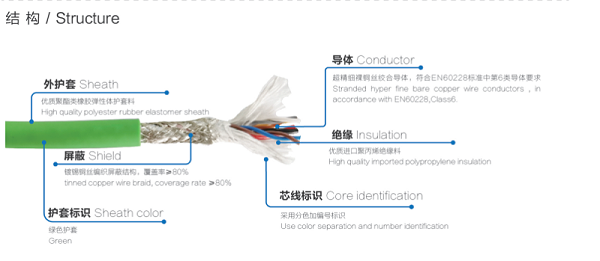
Typical movements include:
The important point is that flexibility alone does not make a cable suitable for continuous motion.
A cable can be soft and flexible but still fail quickly under repeated mechanical stress.
A true continuous flex cable must be designed around factors such as:
In other words, continuous flex cable is not simply "a flexible cable." It is a cable engineered specifically for dynamic applications.
2. How Is Continuous Flex Cable Different from Standard Cable?
This is one of the most important questions when selecting a cable.
Consider two cables:
Cable A: Used to connect a fixed control cabinet to a stationary machine.
Cable B: Installed inside a drag chain and moves back and forth thousands of times every day.
They may carry the same voltage and current, but they do not experience the same mechanical conditions.
A standard cable may be perfectly suitable for Cable A.
For Cable B, however, the cable must withstand repeated mechanical stress.
Standard Cable vs. Continuous Flex Cable
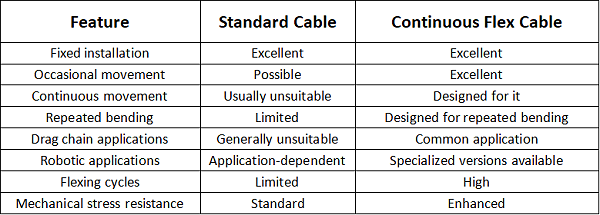
Choosing the wrong cable can result in premature insulation damage, conductor breakage, or complete cable failure.
And when a cable fails inside an automated machine, the cost may extend far beyond the cable itself.
3. How Is a Continuous Flex Cable Constructed?
The internal construction of a continuous flex cable is one of the main reasons it can survive repeated movement.
3.1 Flexible Conductors
The conductor is usually made from finely stranded copper.
Fine strands allow the conductor to bend repeatedly without concentrating mechanical stress in one location.
The basic principle is simple:
Smaller, more flexible strands → better flexibility under repeated movement.
However, conductor design must also balance flexibility with electrical performance, manufacturing requirements, and cost.
3.2 Flexible Insulation
The insulation material protects the conductor while allowing the individual cores to move as the cable bends.
Common insulation materials can include:
The correct material depends on the environment and mechanical requirements.
For example, a cable exposed to oils, abrasion, outdoor conditions, or harsh industrial environments may require a different jacket or insulation material than a cable operating inside a clean factory.
3.3 Cable Core Arrangement
The way individual cores are assembled inside the cable also matters.
A poorly designed internal structure can create excessive friction between components during repeated movement.
A well-designed cable structure helps distribute mechanical stress more evenly.
This becomes particularly important in high-cycle applications.
3.4 Outer Jacket
The outer jacket protects the cable from the surrounding environment.
Depending on the application, the jacket may need to resist:
PUR jackets, for example, are often selected when high abrasion resistance and mechanical durability are important.
PVC may be suitable for many general industrial applications where the environmental requirements are less demanding.
4. Where Are Continuous Flex Cables Used?
Continuous flex cables are widely used in industrial equipment where cables are repeatedly moving.
Common applications include:
CNC machines
Cables move with machine axes and must tolerate repeated travel.
Drag chain systems
Cables installed inside energy chains repeatedly move back and forth during machine operation.
Robotics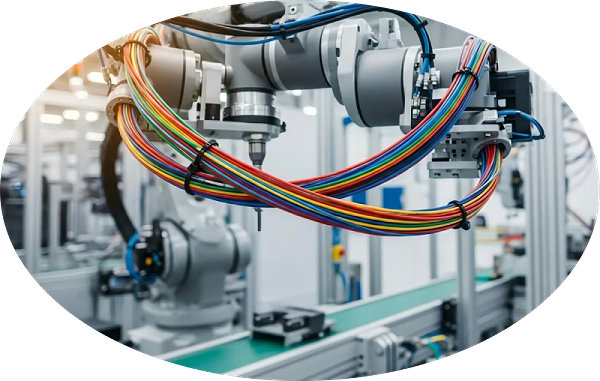
Robot systems may require cables to withstand repeated movement, depending on the robot's motion pattern and cable routing.
Automated production lines
Moving equipment and automated machinery often require dynamic cable solutions.
Material handling systems
Automated handling equipment can expose cables to repeated movement and mechanical stress.
Pick-and-place machines
High-speed repetitive movement makes cable flexibility and mechanical durability especially important.
Industrial machinery
Machine tools, packaging equipment, printing machines, and other automated equipment can all require continuous flex cables.
5. Key Specifications to Consider
Choosing a continuous flex cable based only on conductor size is a common mistake.
Electrical specifications are important, but mechanical requirements can be equally critical.
Here are the major factors to consider.
5.1 Number of Flexing Cycles
How many times will the cable move during its service life?
For some machines, this may be thousands of cycles.
For highly automated equipment, the cable may experience millions of movement cycles.
The expected cycle count should therefore be considered during cable selection.
5.2 Minimum Bending Radius
The minimum bending radius is one of the most important specifications.
If a cable is repeatedly bent tighter than its recommended radius, mechanical stress can increase significantly.
This may lead to:
Always check the manufacturer's specified bending radius before installation.
5.3 Travel Distance
The distance the cable travels during each movement cycle can affect the cable design.
A short-stroke application may have very different requirements from a machine where the cable travels several meters continuously.
5.4 Movement Speed and Acceleration
High-speed movement creates additional mechanical stress.
Two machines may use the same cable length but have very different requirements if one operates slowly and the other moves rapidly with frequent acceleration and deceleration.
Therefore, cable selection should consider:
Travel + speed + acceleration + cycle frequency.
5.5 Temperature
Temperature affects cable flexibility and material performance.
Consider both:
A cable operating in a cold environment may behave differently from the same cable operating in a high-temperature industrial environment.
5.6 Environmental Conditions
Ask what the cable will encounter during operation.
For example:
The cable jacket should be selected according to the actual environment rather than simply choosing the lowest-cost option.
5.7 Electrical Requirements
Mechanical performance is important, but electrical requirements still come first.
Check:
The cable needs to meet both the electrical and mechanical requirements of the application.
6. Continuous Flex Cable vs. Drag Chain Cable
These terms are often used interchangeably, but they are not always exactly the same.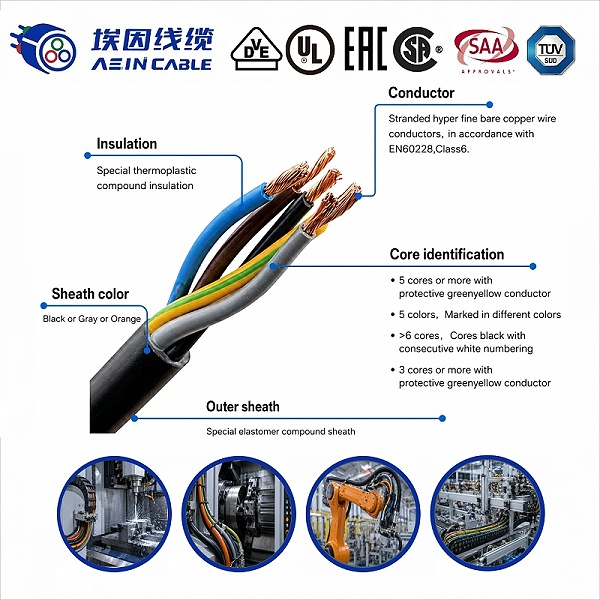
A continuous flex cable describes the cable's ability to withstand repeated movement.
A drag chain cable usually refers to a cable specifically designed for installation in an energy chain or cable carrier.
In many applications, a drag chain cable is a type of continuous flex cable.
However, not every continuous flex cable is necessarily designed for every drag chain application.
For example, a robotic cable may need to withstand torsional movement that is very different from the linear back-and-forth movement inside a drag chain.
Therefore, always match the cable design to the actual movement pattern.
Think about the movement first:
Linear movement → drag chain / energy chain cable
Repeated bending → continuous flex cable
Robot rotation/torsion → robotic cable
Servo motor connection → servo cable designed for dynamic applications
The correct cable depends on how the cable actually moves.
7. Common Causes of Continuous Flex Cable Failure
Even a high-quality cable can fail if it is incorrectly selected or installed.
7.1 Bending Radius Is Too Small
This is one of the most common problems.
Repeatedly bending a cable below its specified radius can significantly shorten its service life.
7.2 Incorrect Cable Arrangement
Cables inside a drag chain should be installed correctly.
Excessive twisting, overlapping, or incorrect spacing can create additional mechanical stress.
7.3 Cable Is Too Tight
A moving cable needs enough freedom to move.
If the cable is installed under excessive tension, mechanical stress can increase during every movement cycle.
7.4 Wrong Cable for the Motion
A standard flexible cable may look similar to a continuous flex cable.
But appearance does not tell you how many flexing cycles a cable can withstand.
Using the wrong cable type is one of the easiest ways to create premature failure.
7.5 Ignoring the Operating Environment
Oil, coolant, chemicals, high temperature, abrasion, and outdoor exposure can all affect cable life.
A cable that works well in a clean factory environment may not perform the same way in a machine exposed to cutting oil or aggressive chemicals.
8. How to Choose the Right Continuous Flex Cable
Before contacting a cable manufacturer or supplier, collect the basic information about your application.
A practical selection checklist is:
Step 1: Identify the Application
Is the cable used for:
Step 2: Define the Movement
Determine:
This information is often more important than simply saying "I need a flexible cable."
Step 3: Calculate the Required Bending Radius
Check the available installation space and compare it with the cable's minimum bending radius.
Never design the system around a bending radius smaller than the manufacturer's recommendation.
Step 4: Check the Environment
Identify exposure to:
Then select the appropriate jacket and material.
Step 5: Confirm Electrical Requirements
Specify:
Step 6: Confirm Standards and Certifications
Depending on the destination market and application, customers may require standards or certifications such as:
Always confirm the actual certification and test requirements for the specific cable model rather than assuming that all cables from a manufacturer have the same approvals.
9. Frequently Asked Questions
Is continuous flex cable the same as flexible cable?
No.
"Flexible cable" is a broad term.
A continuous flex cable is specifically designed for repeated dynamic movement and normally requires a construction capable of handling significantly more mechanical cycling.
Can I use a standard flexible cable in a drag chain?
It depends on the cable.
A cable being described as "flexible" does not automatically mean it is suitable for continuous drag-chain movement.
Always check the manufacturer's dynamic-use specifications.
How long does a continuous flex cable last?
There is no universal answer.
Cable life depends on factors such as:
The same cable may have very different service lives under different operating conditions.
PUR or PVC: Which is better for continuous flex applications?
Neither material is automatically better for every application.
PVC can be suitable for many general industrial applications.
PUR is often selected where higher abrasion resistance, mechanical durability, or resistance to certain industrial environments is required.
The correct choice depends on the actual application.
How do I know if a cable is suitable for my machine?
Ask the manufacturer for the cable's dynamic specifications.
Important information includes:
A good cable supplier should be able to match the cable to your actual operating conditions.
Looking for reliable industrial cable solutions?
AEIN Cable has over 14 years of experience in manufacturing:
• UL CMP Plenum Cable
• Servo Cable
• Drag Chain Cable
• Robot Cable
• Continuous Flex Cable
Visit https://www.aein-wirecable.com to explore our products and technical resources.