
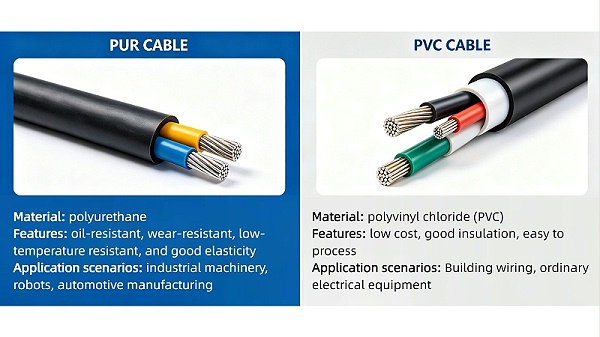
A drag chain cable, also known as a continuous flex cable, is designed for applications where the cable experiences constant movement, bending, and torsion inside cable carrier systems.
These cables are widely used in:
CNC machines
Industrial robots
Packaging machinery
Automated production lines
Servo systems
Material handling equipment
Unlike standard cables, drag chain cables must withstand millions of bending cycles without cracking or signal failure.
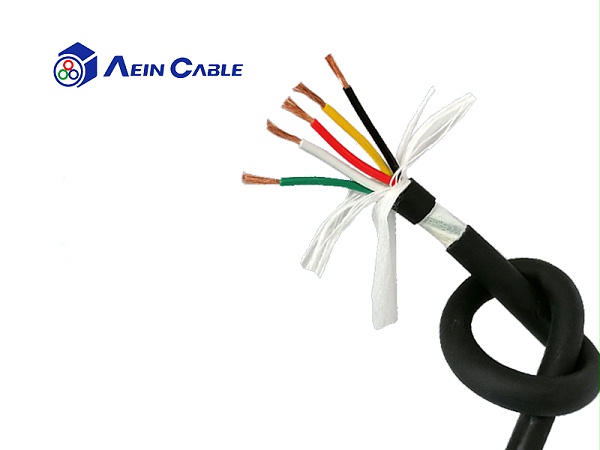
PVC (Polyvinyl Chloride) is one of the most commonly used cable jacket materials due to its low cos
t and good general-purpose performance.
Economical price
Easy to process
Good insulation properties
Suitable for standard industrial environments
Limited flexibility
Poor abrasion resistance
Lower oil resistance
Can crack under continuous bending
Shorter service life in drag chains
PVC cables are usually suitable for light-duty or static applications rather
than high-speed continuous flex systems.
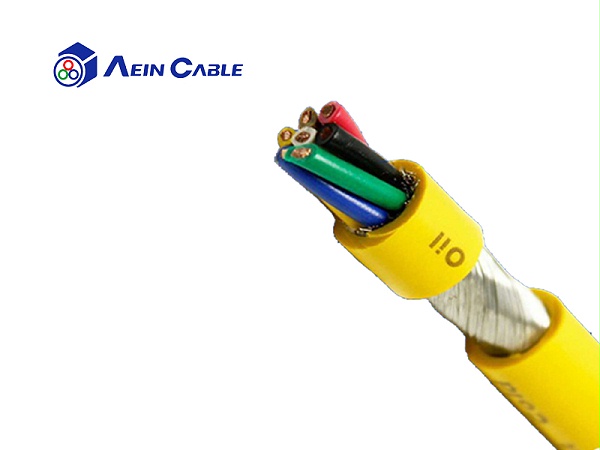
PUR (Polyurethane) is a high-performance cable jacket material designed for harsh industrial environments and dynamic motion applications.
PUR cables are commonly used in:
High-speed drag chains
Robotics
Automation systems
Servo motor applications
Harsh industrial environments
Excellent flexibility
Outstanding abrasion resistance
Superior oil resistance
Longer bending life
Better mechanical strength
Resistant to coolants and chemicals
Higher cost
More complex manufacturing process
Although PUR cables are more expensive than PVC cables, they usually provide a much longer service life in continuous flex applications.
Flexibility is one of the most important factors for drag chain applications.
PVC becomes relatively stiff after long-term bending and may crack under repeated flexing.
PUR maintains excellent flexibility even under continuous motion and small bending radii.
For high-flex drag chain systems, PUR is clearly superior.
Drag chain cables constantly rub against cable carriers and nearby cables.
PVC has moderate abrasion resistance but wears relatively quickly in high-speed applications.
PUR offers outstanding wear resistance and is ideal for harsh industrial environments.
PUR cable significantly outperforms PVC in abrasion resistance.
Industrial automation systems often operate in oily environments.
PVC has limited resistance to industrial oils and chemicals.
PUR is highly resistant to oils, coolants, grease, and chemicals.
PUR is the preferred choice for demanding industrial conditions.
Cable lifespan directly affects maintenance costs and machine downtime.
PVC cables may fail after a relatively short period in continuous flex systems.
High-quality PUR drag chain cables can withstand millions of bending cycles.
PUR provides a significantly longer service life.
PVC cables are more affordable and suitable for budget-sensitive projects.
PUR cables have a higher upfront cost.
However, the longer lifespan often reduces long-term replacement and maintenance costs.
For light-duty applications, PVC may be sufficient.
For continuous flex industrial systems, PUR usually provides better long-term value.
PVC cable may be suitable when:
The cable movement is limited
The application is low-speed
Budget is the primary concern
The environment is relatively clean
Flexing frequency is low
Typical applications include:
Static installations
Basic control systems
Low-cost machinery
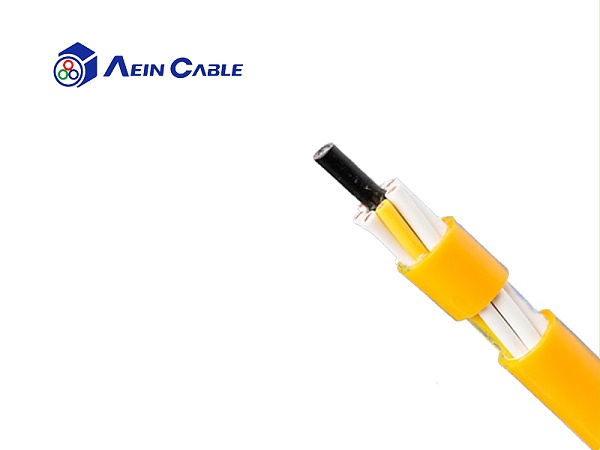
PUR cable is recommended when:
Continuous flexing is required
The system operates at high speed
The environment contains oil or chemicals
Long service life is critical
Machine downtime must be minimized
Typical applications include:
Drag chain systems
Robot arms
CNC machinery
Servo systems
Industrial automation equipment
One of the most common mistakes is using ordinary PVC cable in continuous motion systems.
Standard PVC cables are not designed for millions of bending cycles and may crack quickly.
Incorrect bending radius can dramatically shorten cable lifespan.
Always follow the manufacturer’s recommended minimum bending radius.
Low-cost cables may lead to:
Frequent replacement
Production downtime
Higher maintenance costs
In many cases, premium PUR cables are more cost-effective over time.
For most industrial drag chain applications, PUR cable is generally the better choice.
It provides:
Better flexibility
Longer service life
Higher abrasion resistance
Superior oil resistance
Better performance in harsh environments
PVC cable may still be suitable for low-flex or budget-sensitive applications, but for high-performance automation systems, PUR drag chain cables are usually the preferred solution.
Yes, but only in light-duty applications with limited movement. Standard PVC cables are not ideal for continuous flex systems.
Cable cracking is often caused by:
Poor flexibility
Incorrect bending radius
Low-quality jacket material
Excessive mechanical stress
High-quality PUR drag chain cables can withstand millions of bending cycles depending on operating conditions.
Yes, PUR cable is usually more expensive initially, but it often reduces long-term maintenance and replacement costs.
Choosing the right cable material is essential for reliable drag chain performance.
While PVC cables offer a lower initial cost, PUR cables provide superior flexibility, durability, and service life for demanding industrial automation systems.
For applications involving continuous motion, robotics, and high-speed machinery, PUR drag chain cable is generally the better long-term investment.
We provide high-flex industrial cable solutions for:
Drag chain systems
Servo applications
Robotics
CNC machinery
Industrial automation
Contact our engineering team today for technical support, custom cable solutions, and OEM manufacturing services.