
Introduction: The Hidden Factor Behind Servo System Reliability
In modern industrial automation, precision is everything.
Robotic arms must move accurately. CNC machines must maintain positioning accuracy. Automated production lines must operate continuously without interruption.
Behind every high-performance servo system, there is a small but critical component:
The servo cable.
Many engineers carefully select:
But the cable connecting these components is sometimes overlooked.
A common question is:
Should I choose a shielded servo cable or an unshielded servo cable?
At first glance, both cables may look similar.
They can carry power.
They can connect servo motors.
They can fit the same equipment.
However, inside an industrial environment, the difference can determine whether your automation system runs smoothly — or experiences unexpected problems.
What Is a Shielded Servo Cable?
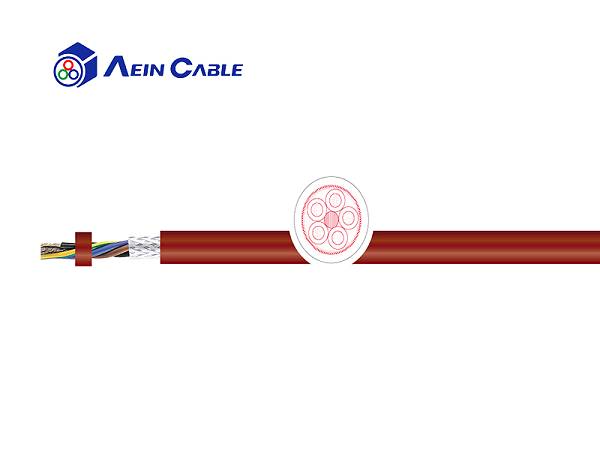
A shielded servo cable is designed with an additional protective layer that reduces electromagnetic interference (EMI).
The shielding layer is usually made from: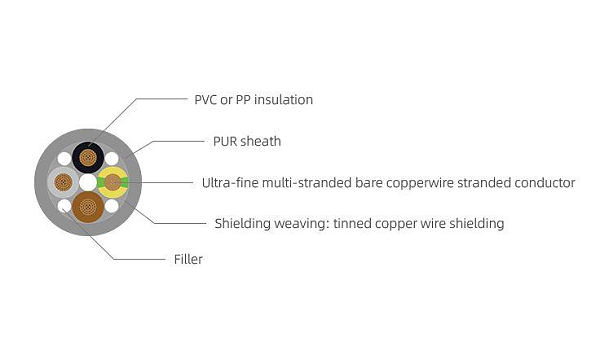
Its purpose is to block external electrical noise and prevent interference from affecting signal transmission.
A typical shielded servo cable structure includes:
Outer JacketThis design helps maintain stable communication between:
What Is an Unshielded Servo Cable?
An unshielded servo cable does not contain an additional electromagnetic protection layer.
It is mainly used in environments where electromagnetic interference is low.
Typical applications include: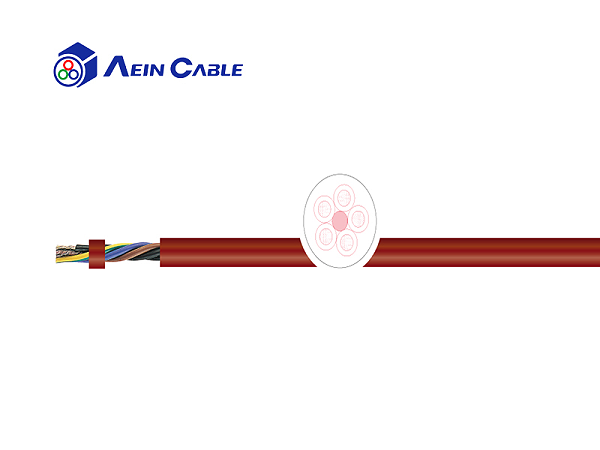
Advantages include:
✔ Lower cost
✔ Smaller diameter
✔ Easier installation
However, because there is no shielding protection, performance may be affected in environments with strong electrical noise.
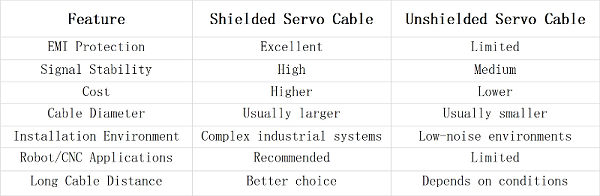
1. Electromagnetic Interference (EMI) Protection
This is the most important difference.
Modern factories contain many sources of electromagnetic noise:
These devices can generate electrical interference that affects sensitive signals.
For servo systems, interference can cause:
A shielded servo cable acts as a protective barrier, helping maintain stable signal transmission.
2. Motion Accuracy and System Performance
Servo motors rely on feedback signals.
The encoder continuously sends information about:
The servo controller uses this feedback to make real-time adjustments.
If interference disrupts these signals, the system may experience:
For applications requiring high precision, such as:
a shielded servo cable is usually the safer option.
3. Installation Environment Matters
The right choice depends on where the cable operates.
Choose Shielded Servo Cable When:
✔ Servo drives
✔ Frequency converters
✔ Industrial robots
✔ CNC machines
✔ Automated production lines
✔ High electromagnetic noise
✔ Long cable distances
✔ Multiple power cables nearby
✔ High precision requirements
Unshielded Servo Cable May Be Suitable When:
✔ The environment is electrically clean
✔ Cable length is short
✔ The system has low sensitivity requirements
✔ Cost optimization is important
4. Flexible Movement Requirements
Industrial automation cables are often exposed to mechanical stress.
Examples:
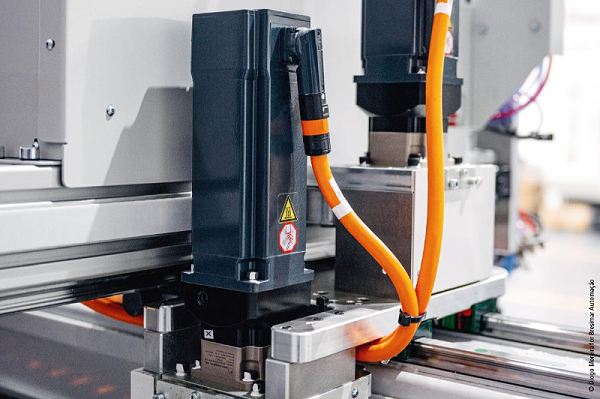
A good servo cable must handle:
For dynamic applications, shielding alone is not enough.
The cable should also have:
A shielded but poorly designed cable may still fail under continuous movement.
Common Mistakes When Choosing Servo Cable
Mistake 1: Choosing Only Based on Price
Many customers choose unshielded cables because they are cheaper.
However, the cost of cable failure can be much higher:
The cable is a small investment compared with the entire automation system.
Mistake 2: Assuming All Servo Cables Are the Same
Two servo cables may look identical externally.
But their differences may include:
The internal design determines long-term reliability.
Mistake 3: Ignoring Cable Installation
Even the best shielded servo cable may not perform properly if installed incorrectly.
Important considerations:
How to Select the Right Servo Cable for Your Application
Before choosing a servo cable, ask:
1. What type of equipment will use the cable?
Examples:
2. Does the system require encoder feedback?
If yes, signal protection becomes critical.
3. Is the cable installed in a high-noise environment?
If your equipment operates near:
shielding is strongly recommended.
4. Does the cable move continuously?
For moving applications, choose:
Why AEIN Focuses on Reliable Servo Cable Solutions
At AEIN Cable, we understand that cable performance directly affects automation system reliability.
A servo cable is not simply a connection between two components.
It is responsible for:
AEIN provides industrial cable solutions including:
Our goal is to help automation manufacturers select cables that match their real working conditions.
Final Thoughts: Shielded or Unshielded Servo Cable?
There is no universal answer.
The right choice depends on:
For simple, low-noise applications, an unshielded servo cable may be sufficient.
But for modern industrial automation systems requiring stability, accuracy, and long service life:
A shielded servo cable is often the better investment.
Because in automation, a small cable decision can have a big impact on overall system performance.