
The outer jacket is the first layer of protection against the surrounding environment.
While conductors carry electrical power or signals and insulation separates electrical components, the jacket protects the internal cable structure from external damage.
Depending on the application, a cable jacket may need to withstand: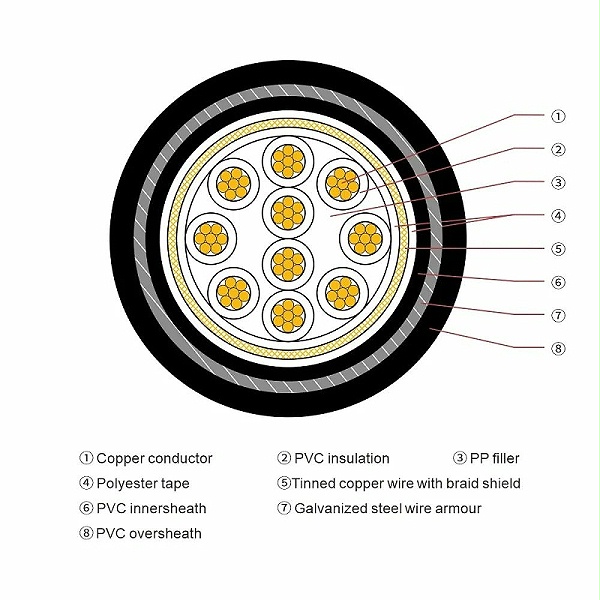
Mechanical abrasion from continuous movement or contact with equipment
Oil, grease, and other industrial fluids
High or low operating temperatures
Moisture, sunlight, and outdoor weather conditions
Repeated bending and twisting
Chemical exposure and environmental stress
A cable designed for a fixed installation may perform well for years in a control cabinet. However, the same cable may wear out quickly inside a moving drag chain.
Why? Because the operating conditions are completely different.
This is why selecting a cable based only on its voltage rating or conductor size is not enough. The jacket material must also match the actual working environment.
There is no single jacket material that is suitable for every industrial application.
PVC, PUR, and TPE are commonly used in industrial cables, but each offers different performance characteristics.
PVC (Polyvinyl Chloride) is widely used in power cables, control cables, and general-purpose industrial cables.
Its main advantages include:
Good electrical insulation properties
Good resistance to moisture
Suitable flexibility for many fixed and moderately flexible applications
Good overall cost performance
Availability in different formulations for specific requirements
However, standard PVC compounds may not provide sufficient resistance to continuous flexing, severe abrasion, or certain oils and chemicals.
For this reason, PVC is often a practical option for fixed installations and general industrial environments, provided the specific compound meets the application requirements.
PUR (Polyurethane) is frequently selected for industrial cables that require better mechanical protection.
Its advantages can include:
High abrasion resistance
Good tear resistance
Good resistance to many oils and industrial fluids
Good flexibility, depending on the formulation
Suitability for demanding moving-cable applications
PUR jackets are commonly found in drag chain cables, robot cables, servo cables, and other flexible industrial cables.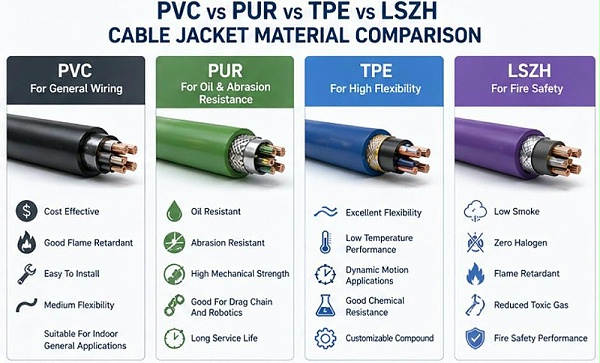
For example, a cable installed on an automated production line may experience continuous movement, friction, and contact with lubricants. In this situation, a properly designed PUR jacket can offer important advantages over a general-purpose PVC jacket.
However, PUR is not automatically suitable for every environment. Its resistance to moisture, hydrolysis, chemicals, and temperature must be evaluated according to the specific PUR formulation and working conditions.
TPE (Thermoplastic Elastomer) combines characteristics of rubber-like elasticity with thermoplastic processing.
Depending on the formulation, TPE jackets can offer:
Good flexibility
Elastic recovery
Resistance to low temperatures
Good weather resistance in suitable grades
Performance for selected dynamic applications
TPE is used in various flexible cables, including industrial equipment cables and applications requiring flexibility under changing temperature conditions.
However, TPE is a broad material family. Its oil resistance, abrasion resistance, flame performance, and temperature range depend on the specific compound.
The right choice should always be based on the actual technical requirements rather than the material name alone.
Instead of asking which jacket material is the best, start by understanding how and where the cable will be used.
Here are five important questions every cable buyer and equipment manufacturer should consider.
This is one of the most important considerations.
A cable used in a fixed installation does not experience the same mechanical stress as one moving continuously inside a drag chain or robotic arm.
For dynamic applications, consider:
Repeated bending cycles
Minimum bending radius
Torsional movement
Acceleration and travel speed
Expected service life
A suitable jacket must work together with the conductor stranding, insulation, and overall cable construction.
Simply choosing a flexible jacket does not guarantee that the complete cable is suitable for continuous movement.
Industrial environments often contain lubricants, hydraulic oils, cleaning agents, and other chemicals.
If the cable is exposed to these substances, a general-purpose jacket may deteriorate over time.
Possible signs of damage include:
Surface swelling
Softening or hardening
Cracking
Loss of mechanical strength
Before selecting a cable, identify the type of fluid, exposure frequency, temperature, and contact conditions.
An oil-resistant cable should be selected according to its actual resistance test results and the specific substances it will encounter.
Temperature affects the flexibility, durability, and mechanical properties of cable jacket materials.
At low temperatures, some materials may become stiff or brittle. At high temperatures, they may soften, age faster, or lose their mechanical strength.
When selecting a jacket, consider both the minimum and maximum operating temperatures.
Also distinguish between continuous operating temperature and short-term exposure to higher temperatures.
Outdoor applications introduce additional challenges, including sunlight, UV exposure, rain, humidity, and temperature fluctuations.
Not every cable jacket is designed to withstand long-term outdoor exposure.
If the cable is installed outdoors, check its UV resistance, weather resistance, moisture resistance, and applicable temperature range.
For indoor industrial installations, abrasion, oil resistance, and mechanical stress may be more important.
Cable jacket selection is not only about mechanical performance.
Depending on the market and application, buyers may also need to consider:
Flame-retardant requirements
Applicable UL or CSA standards
EN 60332 flame propagation requirements
RoHS compliance
Project-specific technical specifications
It is important to remember that a material name alone does not prove compliance with a particular standard.
Always check the cable's actual certification, test reports, and technical documentation.
The consequences of incorrect jacket selection often appear gradually.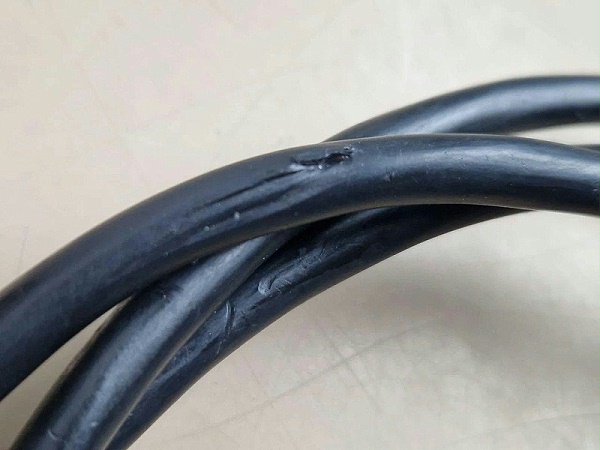
At first, the cable may seem to work normally. After weeks or months of operation, however, problems may begin to emerge.
Premature Abrasion
When a cable repeatedly rubs against machine components or other cables, an unsuitable jacket may wear through, exposing the internal layers.
Cracking and Brittleness
In unsuitable temperature conditions, a jacket may lose flexibility and develop cracks, increasing the risk of insulation damage.
Oil and Chemical Damage
Incompatible materials may swell, soften, or deteriorate after prolonged exposure to industrial fluids.
Unexpected Equipment Downtime
When a cable fails, the consequences may extend beyond the cost of replacing the cable. Production interruptions, maintenance labor, and delayed deliveries can create much larger expenses.
This is why the cheapest cable is not always the most economical choice.
A cable with a suitable jacket and construction may cost more initially but help reduce replacement frequency and maintenance costs over its service life.
One common mistake in cable purchasing is focusing too much on a single material specification.
For example, a PUR jacket may provide excellent abrasion resistance, but that does not automatically make the complete cable suitable for a high-speed drag chain.
Cable performance depends on several factors working together:
Conductor material and stranding
Insulation material and thickness
Shielding structure, where required
Core arrangement and stranding design
Jacket material and thickness
Minimum bending radius
Dynamic performance and mechanical testing
For moving applications, the cable must be designed as a complete system.
A suitable jacket cannot compensate for an unsuitable conductor structure or poor internal cable construction.
This is particularly important for drag chain cables, servo cables, and robot cables, where continuous movement places repeated stress on the entire cable.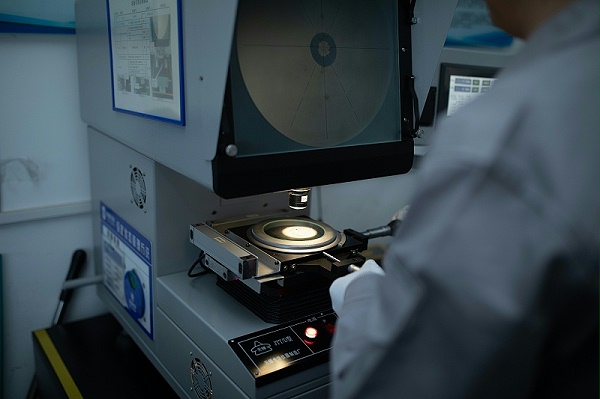
Before requesting a quotation, provide your cable supplier with as much application information as possible.
A clear technical requirement helps suppliers recommend a more suitable cable instead of simply offering the lowest-priced option.
Consider preparing the following information:
Application: Fixed installation, drag chain, robotic arm, or other equipment.
Movement: Continuous bending, torsion, or occasional movement.
Environment: Indoor, outdoor, oil exposure, moisture, or chemical contact.
Temperature: Minimum and maximum operating temperatures.
Electrical requirements: Voltage, conductor size, shielding, and signal requirements.
Standards: Required UL, CE-related requirements, EN, CSA, or other project specifications.
The more clearly the working conditions are defined, the easier it is to select the appropriate cable construction and jacket material.
If your application has special requirements, discuss them with the manufacturer before placing an order.
A high-quality cable is more than good copper and reliable insulation.
Its outer jacket plays an essential role in protecting the internal structure and ensuring reliable operation under real working conditions.
PVC, PUR, and TPE each have their own advantages. The best choice depends on the application, operating environment, mechanical stress, and required service life.
For cable buyers and equipment manufacturers, the key is simple:
Don't choose a cable jacket based only on its material name or initial price. Choose it based on what the cable will actually experience in service.
At AEIN Cable, we focus on industrial cable solutions for demanding applications, including drag chain cables, servo cables, robot cables, power cables, and control cables.
Whether your project requires high flexibility, abrasion resistance, oil resistance, or customized cable construction, selecting the right cable starts with understanding your application.
Have a specific cable requirement? Contact AEIN Cable to discuss your application and find a suitable cable solution.
Website:https://www.aein-wirecable.com/